

In the aftermath of the COVID-19 pandemic Qantas took a lot of criticism for the slow return of the A380 fleet. This was complicated by the return to service from storage coinciding with a significant round of heavy maintenance checks and cabin refurbishments.
We opined at the time that Qantas encountered a perfect storm with the return to service coinciding with a lack of global heavy maintenance capacity and challenging supply chains. The fact that many of Qantas A380s were due major 12 year D-checks wasn’t something within their control at the time but rather the externality of the timing of the pandemic. Another factor was that Qantas prioritised the return to service of smaller widebody aircraft to mitigate capacity risk in an uncertain environment.
It’s notable that Qantas’s A380 fleet is older than many peer carriers. For example, at present, Qantas’s A380 fleet averages 17.1 years compared to 10.8 years at Qatar Airways, 11.1 years at Etihad, 11.8 years at Emirates, 12.5 years at British Airways, 12.7 at Singapore Airlines, 13.4 years at Korean Air, and 14.5 years at Lufthansa. This makes comparison between the return to service at Qantas and other airlines challenging as the aircraft would’ve been at different points in their heavy maintenance plan.
The A380 has two options for heavy maintenance, utilising a 2 or 3 year interval through a 12 year cycle. Using the 2 year interval, each aircraft will undergo C-checks every second year, with 6 checks over each 12 year cycle. Using the 3 year interval, each aircraft will undergo C-checks every third year, with 4 checks during each 12 year cycle.
Under the 3 year interval system, intermediate checks will be more intensive as more work is compressed into each check. However, by the end of the 12 year cycle, aircraft will conceptually have had the same checks delivered during the plan, ready to begin all over again.
Note that the modern nomenclature describe all heavy maintenance checks as C-checks. Historically, the 6 and 12 year checks were described as D-checks as they are significantly more intensive than the other checks in the cycle. Even then, the 12 year check is significantly more intensive than the 6 year check. The approximate number of tasks to be completed during the checks are as follows:
2 year: 105
4 year: 156
6 year: 348
8 year: 161
10 year: 106
12 year: 606Safe to say, the 6 and 12 year checks will take a lot longer than 2, 4, 8 and 10 year checks, while the 12 year check will also take a lot longer to complete than the 6 year check.
Thus, the average Qantas A380 would’ve been due it’s first 12-year check in 2021, slap bang in the middle of the pandemic, while its peers would’ve had their first 12-year checks due between 2024 and 2027. Father time is now catching up with carriers with younger A380 fleets. This gives us a neat opportunity to see just how long these checks are taking!
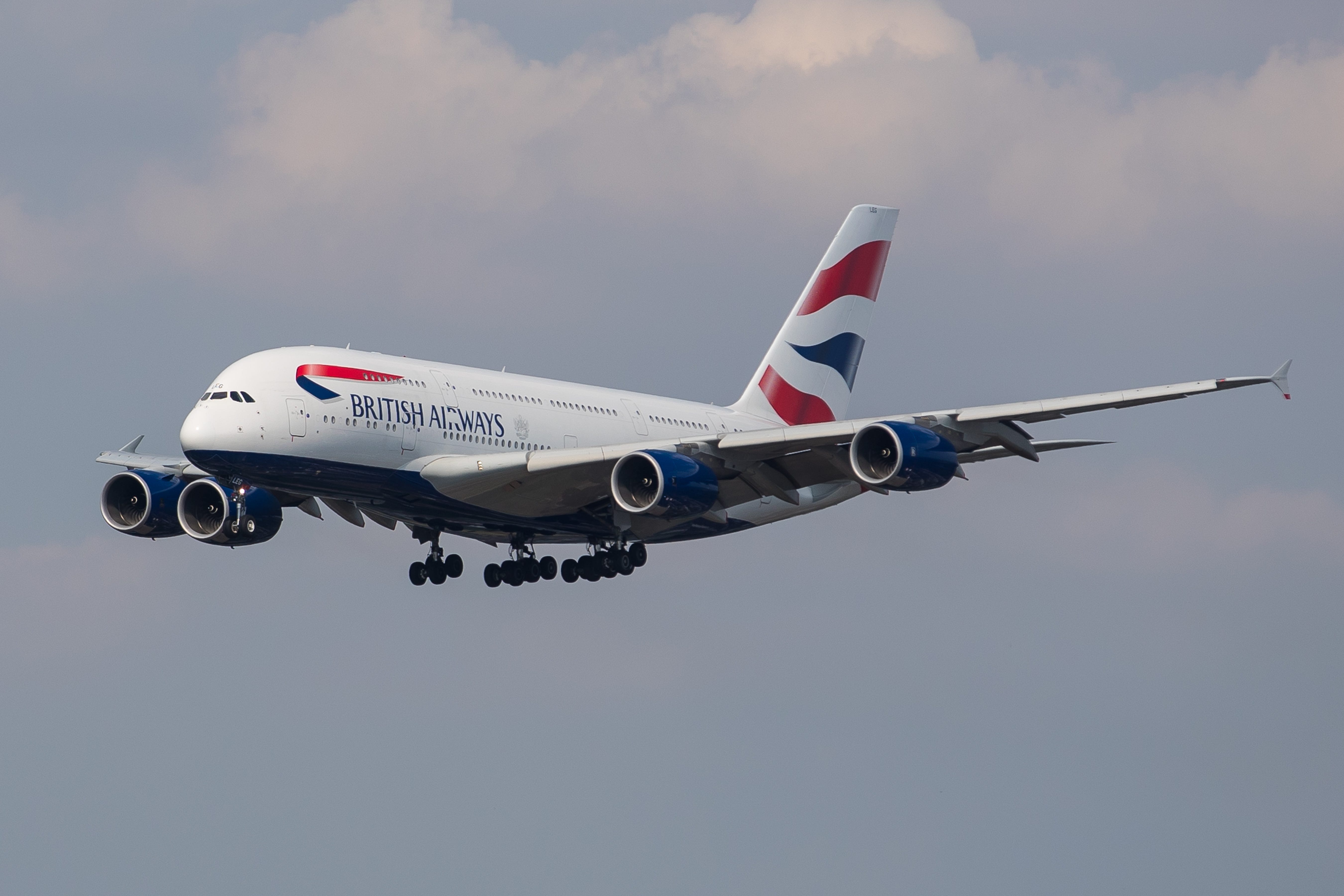
We’ve chosen two carriers to look at in more detail: British Airways and Lufthansa. We’ve chosen these carriers since they’re currently in the middle of their D-check programme with a good sample size to look at. Other carriers make for awkward comparison, for example, Korean have a relatively small fleet and thus a small sample size, while Emirates’s fleet is also undergoing a cabin refurbishment. While BA and Lufthansa have forthcoming cabin refurbishments scheduled, the contemporary D-checks haven’t yet included cabin refurbishments.