

Unless you’ve been living under a rock you’d have been following the chaos that global travel has been thrown into by the conflict in the Middle East. The temporary closure of airspace in multiple countries has led to the effective grounding of several airlines, including Emirates, Etihad and Qatar. This has had a considerable impact on travel to/from Australia, as well as many other countries.
It’s disproportionally impacted Australia given the importance of these airlines to international capacity. In the last year, they carried 4.6 million passengers to/from Australia, accounting for 10% of all passengers (12 months to September 2025).
The effects are particularly felt traveling between Australia and Europe, given the relative importance of their connecting capacity. Data presented by Virgin and Qatar during their ACCC JV application showed that they held substantial market shares between Australia and Europe. In the year ended May 2024, the ME3 accounted for 44% of the Australia-UK market, and 64% of the market between Australia and the rest of Europe.
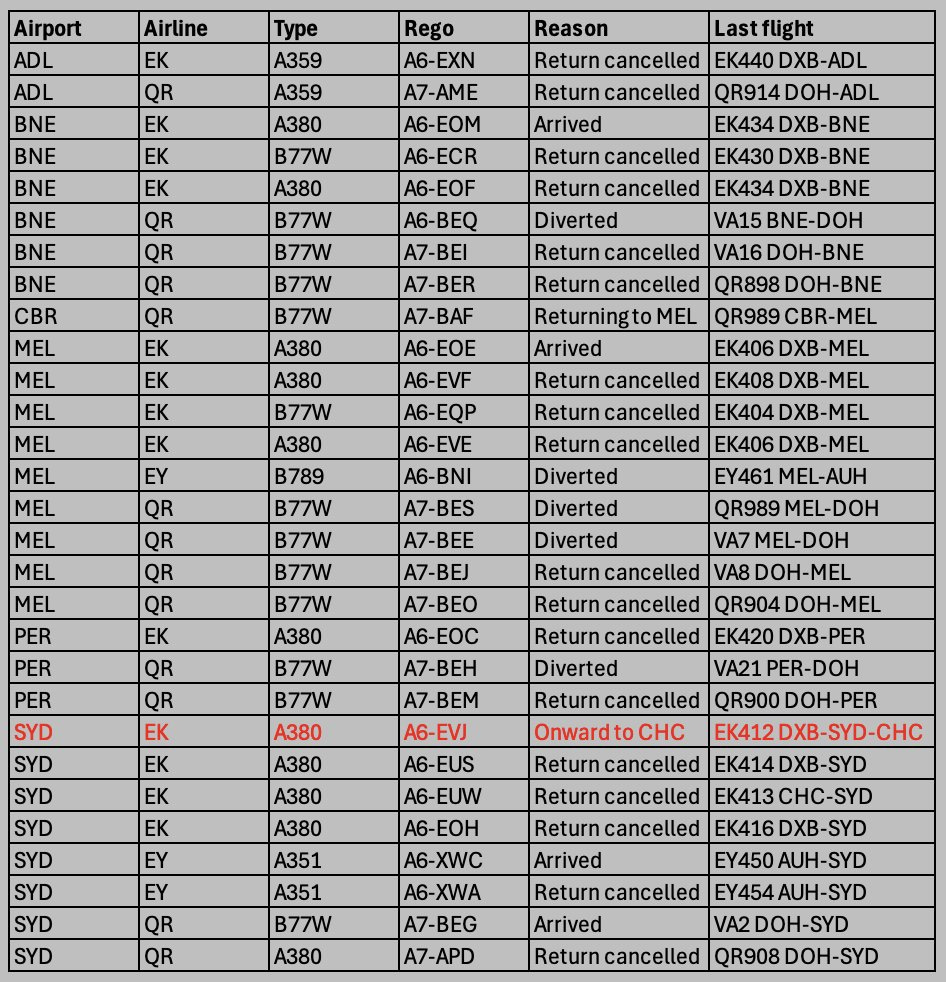
The loss of this capacity is near catastrophic. Now into its third day, it’s affecting about 13,000 passengers a day just to/from Australia. The fleet is grounded, with many aircraft and crew “stranded” at outstations. Just in Australia there are 30 widebody aircraft on ground, with 9 at Melbourne and 8 at Sydney alone!
We’ve been getting lots of questions asking why don’t they just fly these aircraft direct to Europe, bypassing their hubs in the Middle East, utilising regional hubs in Southeast Asia instead? For example, people have proposed flying Sydney-Singapore-London, arguing that a large proportion of passengers on ME3 flights stuck in Sydney are headed to London.
While they don’t have the appropriate traffic rights under existing bilateral air service agreements, force majeure makes a case to allow such flights, even if just as ad hoc flight to allow stranded travellers to return home. While it would require some bureaucratic gymnastics to make it happen, it’s difficult to see governments preventing this. However, none of the airlines have indicated any interest or willingness to do this.
While it would be logistically difficult and very costly, it doesn’t really solve the problem. The strength of global connecting hubs is the fragmentation of traffic and diversity of destinations they serve, but it’s now their weakness. While a large proportion of those Sydney passengers might be headed to or from London, not all are, and those that aren’t are fragmented all over their networks, not just Europe. While it might get many passengers home, it won’t get anywhere close to all.
It would provide some relief for some passengers and send a signal of their willingness to mitigate the challenges that many are facing. However, the reason that they’re not doing it is more strategic and possibly for the greater good. It’s because this is their mitigation plan! This sounds ludicrous, right? Okay, but hear us out …
They’ve had months of warning and plenty time to plan it out. They’ve no doubt learned from previous airspace shutdowns over the last few years. Surely they could have come up with a plan to mitigate? Yes, and this is the plan!
Whether it’s the right contingency plan or it’s being well implemented, the plan is to keep the operation primed for a rapid restart. This is their focus, but to have a rapid restart they need aircraft and crew ready and waiting in the right places. And that’s exactly what they’ve done!
We can see this in action from the start. When UAE and Qatari airspace closed on Saturday the plan kicked into gear. There were a few key elementsn:
Flights departing from Abu Dhabi, Doha and Dubai: those that had departed
would continue to their final destination, while flights that were awaiting departure from would be cancelled.
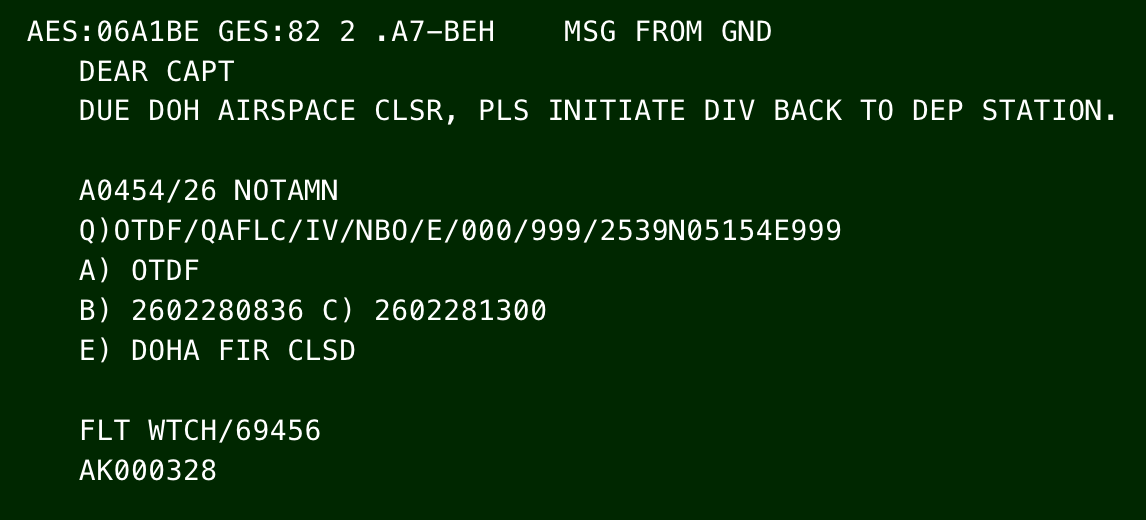
Flights returning to Abu Dhabi, Doha and Dubai from outstations: aircraft that had already departed from outstations to Abu Dhabi, Doha and Dubai would initiate diversions back to their point of origin.
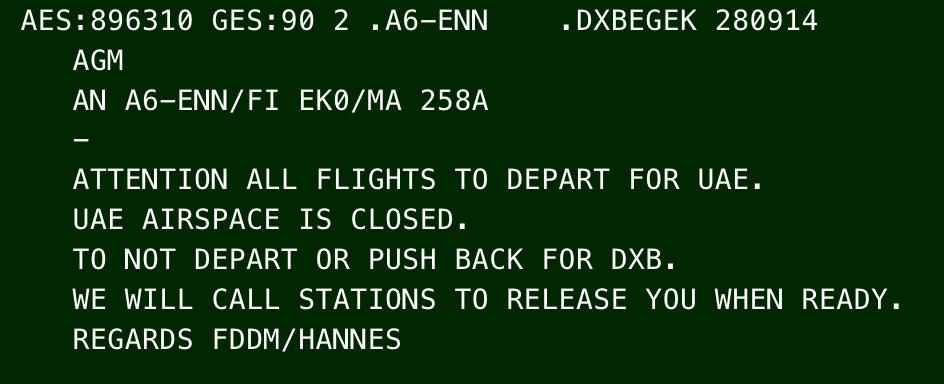
Also flights returning to Abu Dhabi, Doha and Dubai from outstations: Aircraft yet to depart would not depart and remain on ground.
This strategy meant that very few aircraft and crew ended up stranded in the wrong places. Instead of having aircraft continue towards Abu Dhabi, Doha and Dubai in the hope that the airspace reopened by the time they got there, and ending up scattered all over the region, they now have all the aircraft and crews waiting at their point of origin, ready for a rapid restart ops at very short notice.
The success of this strategy is predicated on restarting operations in a matter of days. They can’t drag this out for weeks and months, and in some respects it’s a gamble. This explains why they haven’t implemented another plan, including a complex attempt to reroute flights bypassing their hubs since that’ll just end up with aircraft and crew scattered, slowing down or even breaking any quick restart.
It’s also why we’re not seeing forward looking cancellations. It’s noticeable that at no point have either of Emirates, Etihad or Qatar cancelled flights for an extended period, rather cancelling on a day-by-day basis.
For example, on Monday 2 March (at around 10am UAE time, 5pm AEDT), Emirates announced they were cancelling all flights to/from Dubai up until 3pm UAE time on Tuesday 3 March. This followed a similar announcement on Sunday 1 March, indicating that they were cancelling all flights to/from Dubai up until 3pm UAE time on Monday 2 March. Etihad and Qatar followed the same pattern.
Keeping it day-by-day allows them to restart at a day’s notice, hoping the situation improves sufficiently to allow a restart of flights. Keeping the aircraft and crew at outstations means they’re able to restart at short notice, while starting a bypass operation scatters crews and aircraft, and even if brilliantly planned and executed will end up with crew duty limits potentially impeding a restart.
But this strategy can’t go on indefinitely. You can’t go day-by-day for weeks or months. How long can it go on for? We simply don’t know!
EK leads the field in returning to schedule. But there's risks.
Even today, ca.0800hr DXB time inbounds from MAN, LHR and FRA were holding for 1 hour plus due to drone alerts.
The unmentionable risk?
I'm not even going to say it. But it would be catastrophic. You know it.