

Few things trigger us more than the old wives’ tale that airlines only make money from loyalty programmes and don’t make money from flying. The tale has several variations and sequelae, and generates a range of misconceptions. Some of this stems from a poor understanding of the airline business by commentators, but it mostly stems from a poor understanding of financial accounting practices.
This isn’t to say that loyalty programmes aren’t an immensely important and profitable part of the airlines business, but it’s become a hit-and-run critique of specific airlines and the industry as a whole. We wanted to tackle this question in a sober manner by outlining the financial accounting practices of airline loyalty programmes, not just to dispel the myth, but also to allow readers to better appreciate the actual importance of loyalty programmes.
Part 1
When customers sign up to an airline loyalty programme they are aiming to earn points (or miles as they’re known in some countries) that they can then utilise to redeem for rewards. A secondary consideration is earning sufficient points to gain a higher level of status that increases the rate of earnings for given activities but also avails the customer of a range of benefits from increased baggage allowances, priority check-in, lounge access, etc. In some cases, status benefits themselves can be of considerable value.
Customers earn points through two mechanisms: 1) by flying on the said airline or their partner airlines, and 2) through purchases from external partners. The later include other travel providers like hotels, car hire and even taxis (e.g. taking an Uber to the airport earning a handful of Qantas points), or purchases from non-travel providers. The most significant of these are credit card companies, which have become an increasingly large points earner over time, so let’s focus in on that.
Analytic Flying is a reader-supported publication, so please subscribe. See our ethical paywall policy to understand if you need a paid subscription (incl. industry professionals and readers using for commercial purposes).
I have a NAB Qantas Rewards Premium Credit Card. At present, it’s offering a 60,000 points sign-up bonus if I spend A$3,000 on everyday purchases within the first 90 days of account opening, and a further 40,000 points if I keep the card for 12 months. In addition to the sign-up bonus, I’ll also points on a recurring basis, earning 1 point per $1.50 spend on the first A$3,000 per month, and 1 point for every A$3 thereafter.
If I spend A$6,000 per month on the card, I’ll earn 36,000 points a year plus 100,000 bonus points in the first year. That’s a substantial number of points given that a return business class Melbourne-London flight including the Platinum One status bonus would amount to 80,600 points.
Qantas doesn’t give away the point for free, so NAB must purchase these points from Qantas. The exact price isn’t public, but it’s like any other commercial transaction. Qantas will offer NAB better terms for purchasing more, providing volume guarantees or greater advance purchases, etc. It’s safe to assume that NAB are paying less than A$0.0273 per point (2.73 cents per point) since this is the price (including GST) that Qantas will sell you and I “top-up” points. So let’s assume a price of A$0.02 per point, meaning that it’ll cost NAB A$2,720 to purchase 136,000 points (A$720 for the 36,000 and A$2,000 for the 100,000). That’s probably generous, but let’s run with it for an our instructive example.
Part 2
Some people assume that this results in Qantas generating A$2,720 in revenue as a result. But the financial accounting is more complex than you might think. Until the customers spend those points (or until they expire), Qantas are unable to recognise it as revenue. They certainly have the cash (which sits on the balance sheet as an asset), but they also raise a liability in the form of unearned revenue.
The unearned revenue only gets raised as revenue once those points are spent! This is important to note since many assume that airlines make the revenue when they sell points to credit card companies, however financial accounting dictates that they only generate the revenue when customers redeem them. This generates an explicit need and incentives for airlines to get customers to redeem those points!
The most recent financial statements published by Qantas and Virgin (HY26), show that at the end of December 2025, Qantas and Virgin had A$3.7 billion and A$674 million unearned loyalty revenue, respectively, having increased from A$3.6 billion and A$630 million, respectively, six months earlier.
We said it only becomes revenue when miles are used, so how much was used? In the last six months, Qantas and Virgin recognised A$1.4 billion and A$242 million in revenue, respectively, meaning that customers redeemed points for flights and other rewards to these values during the six month period.
What’s also notable is how the net balances changes. In both cases, unearned revenue increased, meaning that the customers accumulated more points than they redeemed (or expired). See the details below for the accounting for that.
The relative net accruals amount to 5.6% of Qantas’s June 2025 balance, compared to 7.0% of Virgin’s June 2025 balance. We might argue that Qantas achieved a higher or more efficient burn rate, but this isn’t a critique of Virgin or a virtue of Qantas.
Qantas
Unearned revenue balance at end June 2025: A$3.368 billion
Revenue earned (July to December 2025): A$1.400 billion
Net balance: A$ 1.968 billion
Actual unearned revenue balance at end December 2025: A$3.556 billion
The difference between the net balance and actual balance is the new points earned (which is A$1.588 billion). So customers accrued more miles than they spend by an amount of A$188 million (A$1.588 billion less A$1.400 billion).
Virgin
Unearned revenue balance at end June 2025: A$630 million
Revenue earned (July to December 2025): A$242 million
Net balance: A$388 million
Actual unearned revenue balance at end December 2025: A$674 million
The difference between the net balance and actual balance is the new points earned (which is A$286 million). So customers accrued more miles than they spend by an amount of A$44 million (A$286 million less A$242 million).
Part 3
A far more important misconception is that this revenue is pure profit. It’s an error that many commentators make because they don’t understand, or don’t want to understand the financial accounting. In some cases, it appears as though commentators intentionally misrepresent this to generate a narrative that airlines don’t make money from flying. It’s not clear why they’d need or want to do this, but when people continue to push the narrative even once the error is pointed out to them, their motives come into question.
When a customer redeems points the airline raises revenue, but the error is made in assuming that no costs are raised to provide the redemption. While those costs may be relatively small, they aren’t negligible. For example, if the customer redeems a reward from an external partner, say a hotel or car rental, the airline will have to purchase the redemption. Even if you redeem a reward on the airline, there is still a cost associated with it. The flight utilises aircraft, crew, fuel and other resources that cost money. Even if the seat on that flight was dead stock, there are still costs associated with it.
In a widely quoted article last year, The Economist published an analysis claiming that “Last year Delta Air Lines notched up an operating profit of $6bn, comfortably ahead of its domestic rivals. Buried in the financial statements, however, was a more revealing point. Without the revenue from its loyalty programme, it would have operated at a loss.”
But alas, this is absolute bullshit!!!
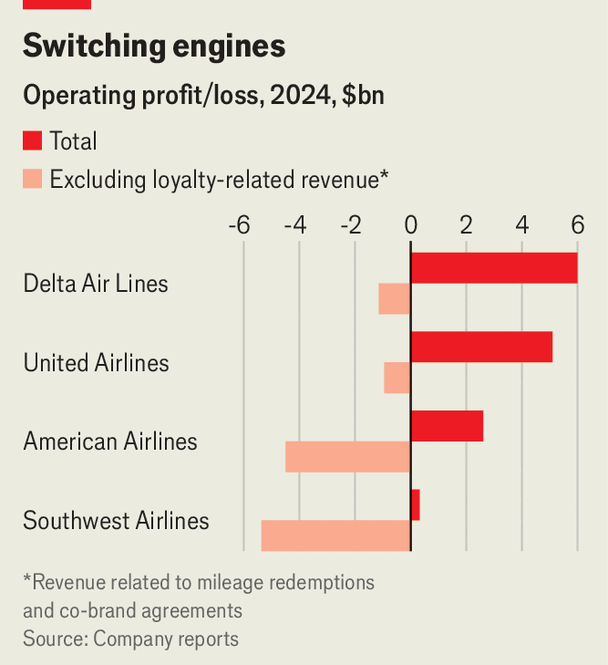
The article correctly states Delta’s 2024 operating profit (or operating income as its called in their financial statements) of $6 billion, however it then claims that after excluding loyalty-related revenue of $7.1 billion that Delta would’ve incurred a loss of more than $1.1 billion. Note that they exclude the revenue, but not the costs! So how did they get to this?
Delta’s financial statements disclose loyalty-related revenue in some detail (see breakdown below). They don’t disclose the costs generating that revenue, and while that might be problematic, it doesn’t mean that one can assume that there are no costs involved in generating that revenue and that revenue equals profit. But inexplicably, and absurdly, The Economist’s analysis simply assumed that Delta incur no costs generating loyalty-related revenue.
Delta’s loyalty-related revenue in 2024:
Delta earned $7.138 billion in loyalty-related revenue in 2024. This is made up of $3.841 billion in travel awards (redemptions of flights), $0.216 billion in non-travel awards, and $3.081 billion in other loyalty revenue. The last part includes brand usage by third parties and other performance obligations embedded in miles sold like lounge access.
A total of $7.138 billion is in revenue is simply subtracted from the operating profit of $5.995 billion was used by The Economist to estimate that Delta would’ve incurred a $1.143 billion loss without this revenue.
The flights for travel awards still require an aircraft, crew, maintenance and fuel. The non-travel awards require Delta to pay suppliers, while lounges cost money to operate. The conceptual misunderstanding of the financial accounting may lead people to assume that the revenue has not cost basis. While Delta don’t do any favours by not spelling out the cost basis in the financial statements, it doesn’t mean we have the liberty of assuming there is no cost basis.
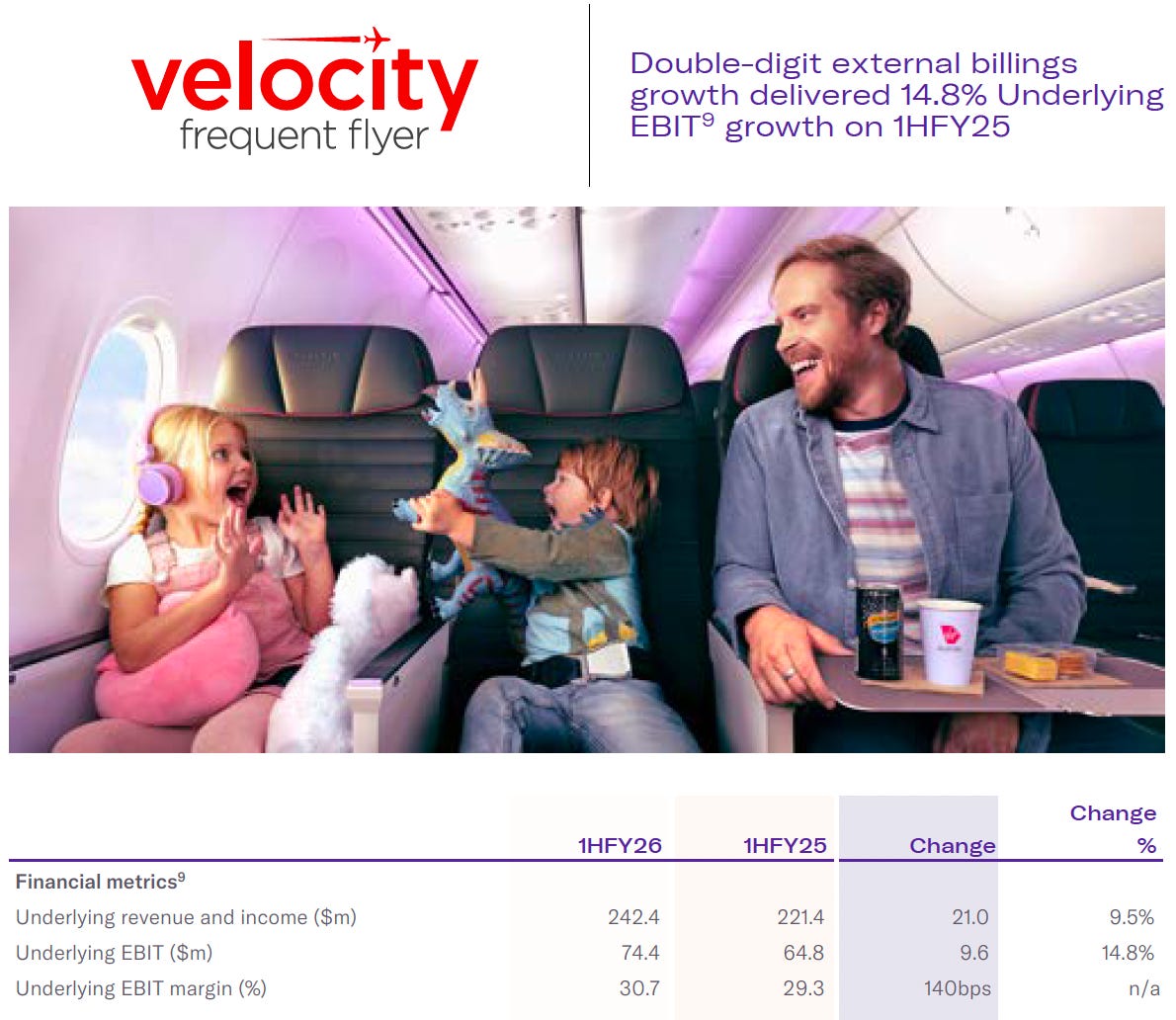
Other airlines spell it out more explicitly. For example, going back to our Qantas and Virgin examples, in the six months to December 2025, Qantas reported an EBIT (earnings before interest and tax) of A$286 million on A$1.4 billion in revenue, while Virgin reported an EBIT of A$74.4 million on A$242.4 million in revenue.

This means that Qantas injured costs of A$1.114 billion to generate their loyalty revenue. While the margin of 20.4% is very high, and much higher than even the best performing airline within the group (Qantas domestic with 16.1%), it still shows that loyalty programs cost money to operate. Meanwhile, Virgin incurred costs of A$168 million to generate that revenue, with a 30.7% EBIT margin, also much higher than the airline’s 13.1% margin.
While we don’t know Delta’s loyalty margin, it would need to be a operating margin of 84% or higher for The Economist’s claim to be true. This isn’t just implausible, but downright laughable!!!
Qantas and Virgin operate their loyalty businesses at 20% to 30% margins, and industry wide estimates put the higher end at 30% to 40%, and as high at 60% to 70% for milage sales, showing just how unlikely it is that the claim is true.
Why is this even important?
I can hear my grandfather saying “yada yada yada, all this talk of numbers is just confusing me. What’s the tachlis, boy?”

Maybe he’s right and this explanation is all just sophistry. Financial accounting is both brilliant and manipulative, and it’s probably not relevant to most people. It’s absolutely necessary for some, but the average punter probably doesn’t give a damn.
So, what’s the tachlis?
Those who make the claim that loyalty programmes make otherwise unprofitable airlines profitable require and use financial accounting to show this. To put it bluntly, we didn’t make the claim. Those who make the claim use financial accounting to show it, however the claim simply doesn’t hold up to scrutiny.
At best, they don’t understand the financial accounting and would earn a failing in high school accounting, and that’s not an exaggeration! At worst, it requires fraudulent accounting to justify, and it’s not even a sophisticated fraud, rather just ignoring the costs associated with the revenue. We don’t argue that The Economist are guilty of this, rather they haven’t understood the accounting. Concerningly, there are plenty of commentators who do this knowingly, likely exaggerating to generate outrage and clicks!
This diverts from legitimate debate around the benefits for airlines beyond profitability, including revenue recognition and cash flow. Airlines generate a lot of cheap working capital from loyalty programmes and this generates poor incentives for airlines, ultimately leading to devaluations of rewards as loyalty programmes becomes too successful. This is probably a seperate discussion altogether that we can come back to in a few weeks.
Analytic Flying is a reader-supported publication, so please subscribe. See our ethical paywall policy to understand if you need a paid subscription (incl. industry professionals and readers using for commercial purposes).
No doubt, some readers will counter that we’re missing the point and that (some) airlines are increasingly reliant on loyalty programmes to generate revenue and profit. We agree with that, but not that it’s a bad thing. The counter argument de facto implies that increasing reliance on loyalty programmes to generate revenue and profit is somewhat of a bad thing, and it’s not.
The extent to which airlines rely on the loyalty programmes to generate revenue and profit varies. For example, it generated 11% and 18% of Qantas’s revenue and EBIT, and 7% and 15% of Virgin’s revenue and EBIT. It generated 12% of Delta’s revenue, but an unknown amount of profit. These are impressive numbers, but let’s consider the counterfactual. What if airlines didn’t have loyalty programmes?
One argument is that they’d have to generate more revenue from flying, meaning higher prices leading to reduced demand. Both would be a poor outcome for consumers. Reductions in demand would lead to reduced supply, leading to reduce capacity. Effectively, loyalty programmes mean that consumers pay lower prices and have more market capacity.
There’s no such thing as a free lunch though, as loyalty programmes have externalities that we shouldn’t ignore either. Sometimes these might be the monetary costs we pay for, e.g. paying a slightly higher price to fly on the airline you’re chasing status on, or using a credit card for a transaction that might be cheaper another way, or even the annual credit card fee. However, we choose to do that! Because we make these choices, they’re not really externalities, rather the price that we willingly pay. If we don’t value it sufficiently, then don’t do it!
The corollary is that the “externalities” of a world without loyalty programmes will be borne by society at large. As individuals we won’t get to choose to pay the higher direct costs. At least we can choose whether to take part the loyalty programme rate race or not.
The bottom line is that loyalty programmes are incredibly important to many airlines, and a significant source of revenue and profit, but it’s safe to say that as a generalisation airlines are not dependent on them for profitability. The claim that flying doesn’t make money and they’d be loss making without them is not supported by evidence. The claim relies on a shoddy understanding of financial accounting.