

It’s nearly a year since Qantas’s first A321XLR (VH-OGA) was delivered to gloomy Sydney on 2 July 2025. It was an inauspicious start with the planned ceremony cancelled due to the inclement weather following countless delays that would continue for several more weeks. While the 2nd aircraft (VH-OGB) arrived in Brisbane on 25 August 2025, it took 84 and 30 days until OGA and OGB’s simultaneous entry into service (EIS) on 25 September 2025.
Nevertheless, Qantas utilised this time productively, with OGA and OGB conducting 346 training, maintenance and positioning flights prior to EIS. This appeared excessive at the time but likely helped ensure a smoother EIS.
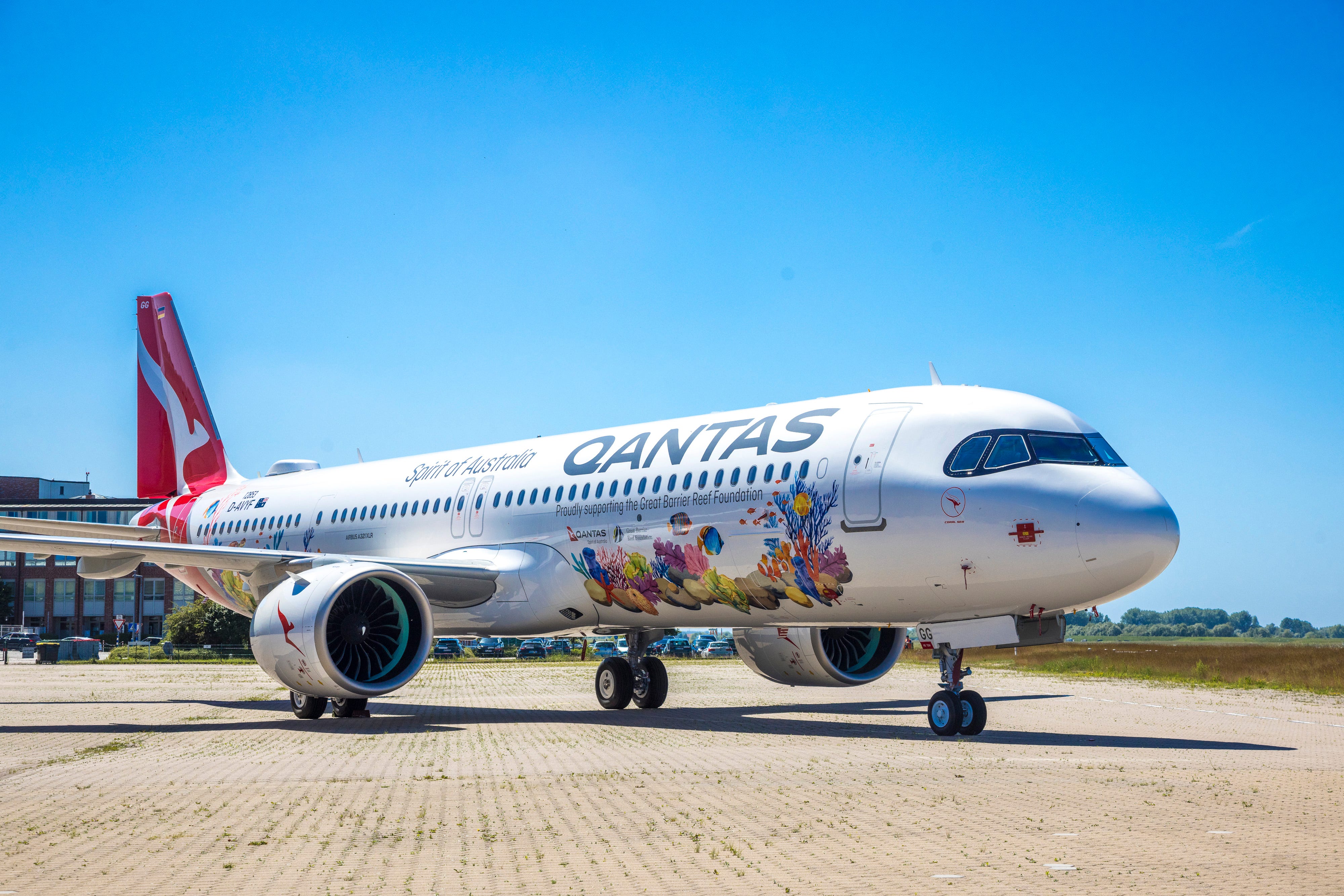
Subsequent deliveries in December 2025 (OGC), and February, April and May 2026 (OGD, OGE and OGF) have entered into service significantly quicker, taking less than two weeks from delivery to EIS. The 7th aircraft (OGG), sporting a special livery supporting Qantas’s partnership with the Great Barrier Reef Foundation, was delivered on 13 June 2026, entering service just one week later.
We thought it would be a good time to have a look at the A321XLR’s EIS program, exploring its route network and utilisation, and looking forward to its likely flying schedule over the next few months. This includes a detailed look at Brisbane-Perth to explore its relative prioritisation in the the A321XLR’s flying schedule over the coming months. This analysis doesn’t try to understand why Qantas have ordered the XLR over the baseline A321neo or A321LR. This has been litigated to death, but we do touch on this in understanding the relative prioritisation of its flying schedule.