

United's low density B787-9: everyone is missing the point about payload restrictions
A few weeks back United Airlines published the seat map of their new low density B787-9 configuration, leaving tongues wagging for the exceptionally large premium, and by contrast small economy cabins. The configuration was actually announced in May 2025, but it received a lot of attention on social media following the publication of the seat map.
The B787-9 is already a major part of United’s widebody fleet with 48 of the type, accounting for 20% of their widebody fleet. In the coming years it’ll become the mainstay of their fleet with at least 141 more on order, slated to replace all of United’s B767, a large chunk of the B777s and providing the opportunity for significant incremental growth.
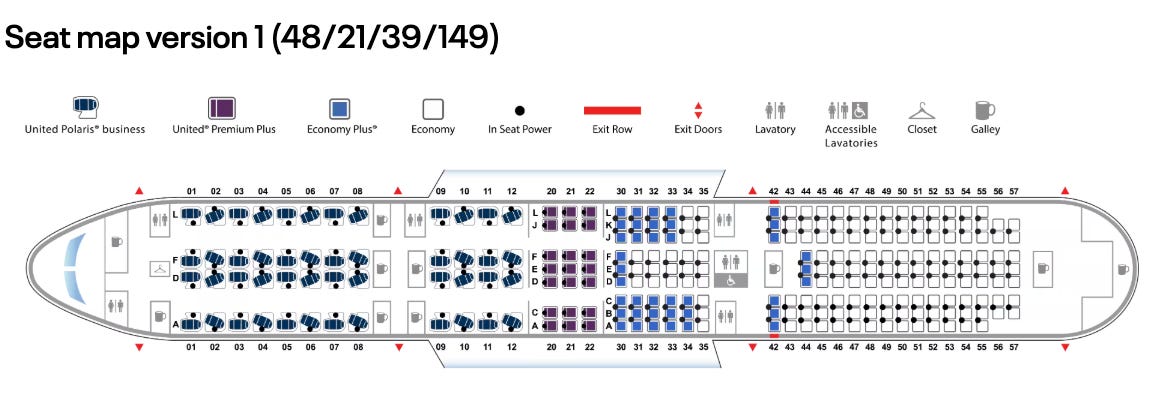
United’s contemporary B787-9 configuration is already relatively premium heavy, seating 257 passengers in a 3-class layout with 48 business, 21 premium economy and 188 economy class seats. United further segment economy class into economy plus and economy, however this is a branding exercise for seats with extra legroom - there’s no need to consider it as a seperate cabin.
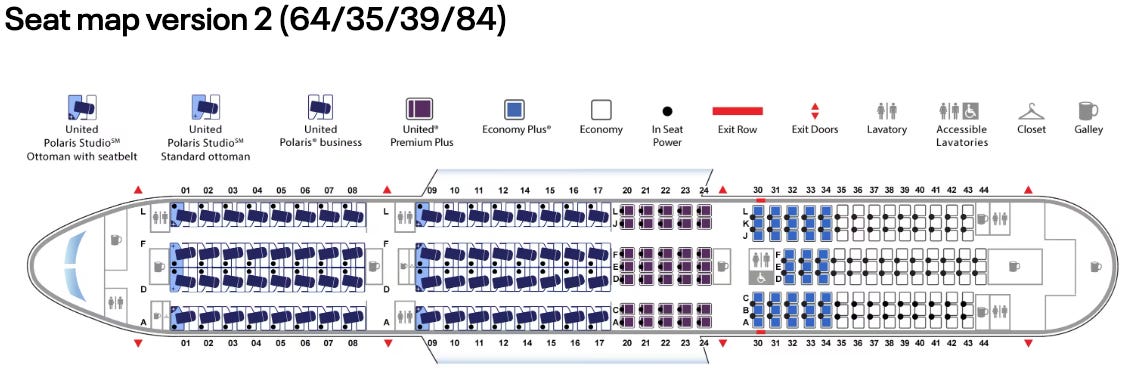
Meanwhile, the new configuration is even more premium heavy, seating 222 passengers in a 3-class layout with 64 business, 35 premium economy and 123 economy class seats. The configuration trades 65 economy class seats for 16 more business class and 14 more premium economy seats. Not all B797-9s will be configured in this very low density version, with United committing to at least 30 aircraft by 2027, likely from new orders rather than reconfiguring existing aircraft.
The commentary on social media is reacting as if this is extraordinary or unusual. While the new configuration does represent a significant reduction in cabin density compared to their contemporary configuration, it’s not extraordinary. In fact, several airlines equip their B787-9s with similar, and sometimes even lower density cabins. For example, Japan Airlines and ANA both have configurations with fewer seats, while Air New Zealand’s forthcoming low density configuration is relatively similar.
But this is somewhat besides the point, as the commentary has missed why United are implementing this new configuration. For example, Kyle Potter from Thrifty Traveler questioned whether it’s an overcorrections to the boom in premium travel, while Zach Griff argued that “United is betting big on premium demand sticking around”. We don’t think it’s an overcorrection or a big bet. Instead, we think it’s about payloads, payload restrictions and United optimising their cabins for their now large ultra long haul (ULH) network, something they hadn’t necessarily contemplated when their inducted the B787-9 in 2014.
Analytic Flying is a reader-supported publication, so please subscribe. See our ethical paywall policy to understand if you need a paid subscription (incl. industry professionals and readers using for commercial purposes).
United’s ULH network
United utilise the B787-9 on some incredibly long missions, many of which are relatively new routes for United. Of United’s ten longest routes, nine are operated by the B787-9, with only Los Angeles-Sydney operated by B777s. Five have been inaugurated since United’s 1st B787-9 was delivered in 2014. This includes the four longest routes. The other five were previously flown on other types (particularly the B747-400 and B777-200ER), and have since been replaced with the more efficient B787-9.
This highlights how the B787-9 has enabled United to open several new ultra long haul (ULH) routes, partly because of the B787-9’s longest range and/or the improved economics at these distances. Critically, United have pushed the range of the B787-9 over time, beyond its initial business case.
However, ULH routes come with significant operational trade-offs in the form of payload restrictions that limit the number of passengers they can carry on each flight. Payload restrictions vary between each route, with significant seasonal variation due to variations in the jet stream and other seasonal weather conditions. Notably, westbound routes are more significantly affected due to the prevailing jet stream.
We can glean a lot into payload restrictions on individual routes using USDOT data that allows us to estimate the variations in available payload between westbound and eastbound flights on the same route on a monthly basis. This is instructive since westbound routes are longer than eastbound routes due to the prevailing jet stream, and as the distance of that the flight covers increases, so the absolute variation in time to fly the westbound and eastbound sector increases.
Available payload on United’s B787-9 flights
Lets have a look at the available payloads on United’s longest B787-9 routes, using San Francisco-Singapore as our primary example. While it’s not United’s longest B787-9, it’s the longest year round and allows us to example how payload restrictions vary over the year.
Over the last year, the westbound sector of United’s San Francisco-Singapore flight averaged an available payload of 27.9t (metric tons), 4.2t less than the 32.1t available on the eastbound sector. This highlights the variation between west and eastbound sectors due to the prevailing jet stream. This is in addition to the seasonal variation, with much larger differences between west and eastbound sectors in the northern winter months between November and April.
The pattern is consistent for most ULH routes, although the magnitude varies route by route. An exception were both Cape Town routes, which might be ascribed to the routing covering a greater north-south rather than east-west distance. Some of the widest gaps were 8.7t for Houston-Sydney and 9.3t for Johannesburg-Newark. In the case of the former, the flight only runs during the northern winter, and thus biasing the sample. It’s for this reason that we focus more attention on San Francisco-Singapore rather than United’s longest B787-9 routes.
In the case of the latter, the variation is due to take-off performance from Johannesburg. While the route still has variation across the year (e.g. the difference is as small as 5.6t in August 2025, and as large as 13.3t in December 2024), the absolute gap is affected by the aircraft’s reduced take-off weight at Johannesburg due to its “hot and high” conditions. The airport is located at approximately 5700ft above sea level, significantly limiting the aircraft’s takeoff performance.
How does this translate into payload restrictions?
The B787-9 has a maximum payload of 52.5t that can be utilised for a combination of passengers and cargo. Rarely will an airline utilise all the available payload as its passenger and/or cargo load will rarely be big enough, or even max out on volume before weight. Meanwhile, on longer flights the available payload will be significantly lower than 52.5t as the aircraft trades some of this payload to carry more fuel.
This might not be obvious, but this trade-off is key to the flexibility of the aircraft, allowing airlines to operate a variety of missions. The B787-9 has a maximum takeoff weight (MTOW) of 254.7t and a maximum zero fuel weight (MZFW) of 181.4t. The MZFW includes its maximum payload of 52.5t, meaning that at maximum payload it’ll only be able to carry 73.3t of fuel, well short of its maximum capacity of 101.4t of fuel. Meanwhile, if it carries its maximum fuel of 101.4t, it means it’s payload will be limited to just 24.4t.
The point at which this trade-off starts to occur varies by aircraft, however ostensibly the B787-9 will start to trade payload for fuel for routes beyond 5300nm (approximately). This varies day-to-day, route-by-route, but as previously noted, United’s ten longest B787-9 routes are all longer than 6364nm, and several significantly longer, meaning that available payload will be significantly less than 52.5t.
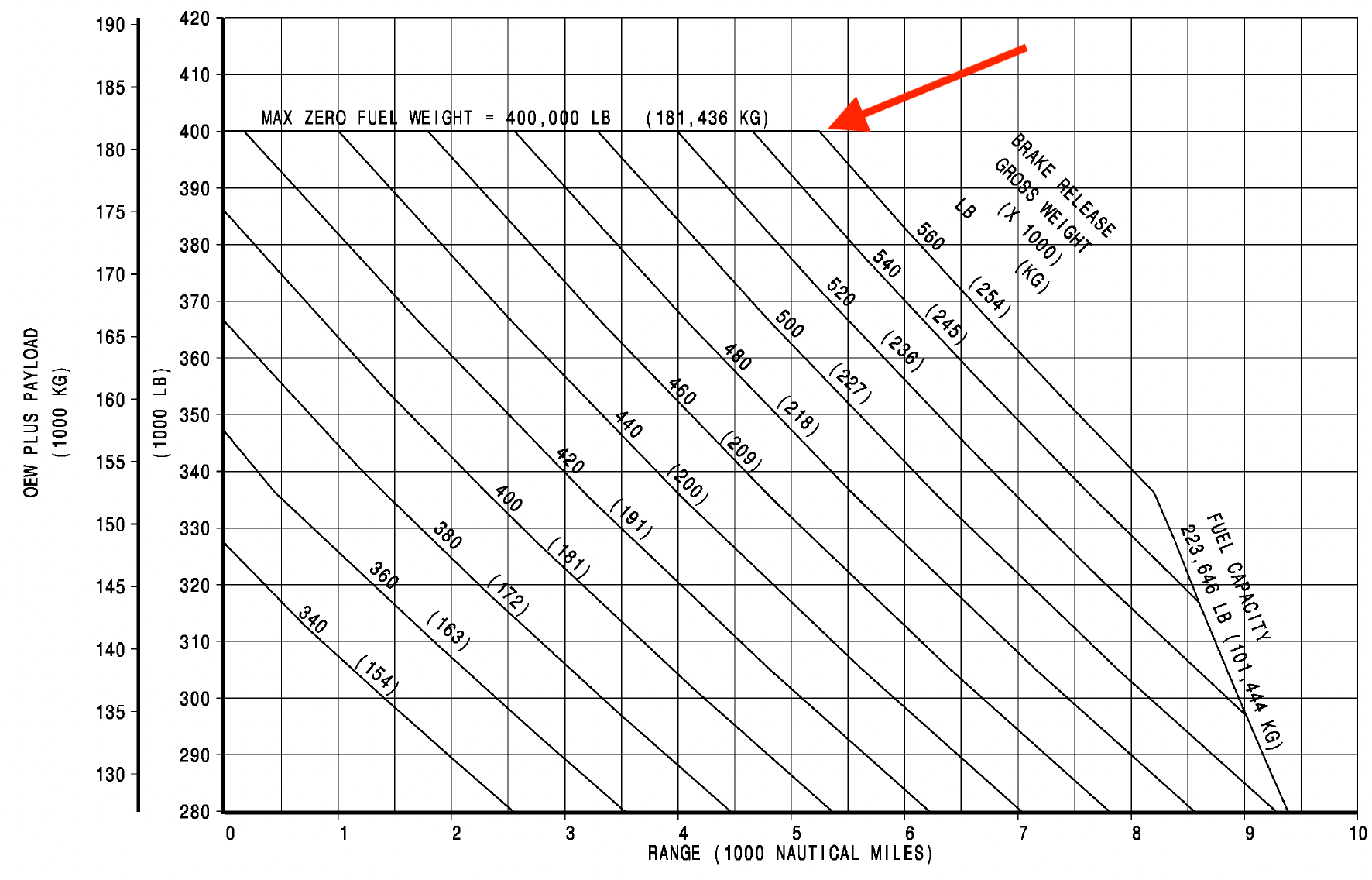
Going back to the San Francisco-Singapore route, over the last year it averaged an available payload of 27.9t and 32.1t for west and eastbound departures, respectively. This means that the westbound and eastbound departures gave up an average of 24.6t and 20.4t of payload in order to carry the required fuel for ULH operations. Recalling that we noted that few routes need to carry the maximum payload, lets consider the practical implications.
Practical implications
Taking United’s contemporary 257 seat configuration, we can estimate the weight of a full passenger load. The standardised FAA estimate is 93-96 kg per person (205-210 lbs), depending on the season. This include carry-on baggage, but not checked luggage. Assuming a full passenger load and an average of 20kg checked luggage per passenger this would amount to a payload of 29.1-29.7t, higher than the 27.9t average available on the westbound San Francisco-Singapore departure.
Not only is this higher than the annual average, it’s higher than the average for 9 of the last 12 months, and as much as 4.7t more than the available payload in the most constrained month. On the average westbound sector this would require a reduction in passenger load of 15 or 16 passengers, however this would be as much as 40 passengers on each westbound sector in the most constrained month (this is itself is an average of the flights during that month with some flights potentially even more).
Houston-Sydney and Johannesburg-Newark will require payload restrictions on the average flight, while Los Angeles-Melbourne will require payload restrictions for most months of the year, and both Cape Town routes for nearly half the year. However, this assumes zero cargo, and any cargo carried will increase the need for payload restrictions.
Furthermore, this only considers westbound routes, with some eastbound ULH sectors also requiring passenger payload restrictions, although during fewer months of the year.
Let’s put ourselves in United’s shoes for a moment
Instead of 257 passengers, your average westbound San Francisco-Singapore sector would be limited to 241 or 242 passengers over the whole year and significantly lower in many month (as low as 217 in the worst month). This would be worse if they needed or wanted to carry cargo.
Somewhat obviously, the airline would want to limit the payload restriction to economy class to minimise the lost revenue from the restriction. And if you operate enough ULH flights subject to payload restrictions like these it might make sense to operate a subfleet with fewer economy class seats. If they can’t be sold then why have them on the aircraft in the first place?!? Not only does it affect revenue but also costs as a restricted passenger load effectively increases the unit cost (cost per available seat mile or kilometer) as costs are shared over fewer available seats.
As simplistic as this sounds, this is exactly what they’ve done. They’re reduced the number of economy class seats by 65 (188 versus 123) on the new low density configuration. While this number is larger than what we might expect because it’s a static metric. Since they’re removing economy class seats, they’ll have more floor space available for more premium seats (business and/or premium economy), meaning that we should be focused on the net change, which is 35 fewer seats (257 versus 222).
The 35 seat net reduction means that a full passenger load would amount to a payload of between 25.1 and 25.6t, slightly less than the 27.9t available on the average westbound San Francisco-Singapore sector. This would requiring a negligible passenger payload restriction during only one month of the year! It’s almost as if they calibrated the configuration to this route!!!
Now United will carry the same number passengers on the route, while the configuration will enable them to earn more revenue while doing so, with more premium seats available for sale. The timing of this discussion is very relevent given our recent analysis of Qantas’s Project Sunrise and the revenue and cost challenges, and opportunities, flying ULH routes.
How to think, not feel about Qantas's Project Sunrise

Project Sunrise, the much vaunted strategy by Qantas to fly non-stop from the eastern seaboard of Australian to London and New York finally looks like coming to fruition in 2027. First announced in 2017, and originally slated to start in 2022, the first A350-1000ULR that Qantas acquired for Project Sunrise will arrive in late 2026. The first Project Sunrise flight - presumably Sydney to London - will likely take place at the start of NS27 season in March 2027.
Conclusion
Firstly, the very low density version is only a subfleet, with at least 30 aircraft by 2027. Expecting that these will be new builds, and not retrofits, this will account for, at most, 38% of the B787-9 fleet. It certainly won’t be the predominant configuration.
Secondly, and most instructively, they’ll debut on San Francisco-Singapore in early 2026. This is their 2nd longest B787-9 route, but their longest year round route as Houston-Sydney only operates in the northern winter season and will end its seasonal run before the new configuration is enters into service. We wouldn’t be surprised to see the new configuration on Houston-Sydney next year.
Its entry into service on the longest route on the network is strongly indicative of its purpose: to compensate for the higher unit costs imposed by payload restrictions on ULH flights with higher unit revenues enabled by larger premium cabins! If you’re going to leave seats empty on enough routes, it’ll pay you to just remove those seats and if you have more space, then it’ll also pay you to utilise that space for higher yielding passengers.
Analytic Flying is a reader-supported publication, so please subscribe. See our ethical paywall policy to understand if you need a paid subscription (incl. industry professionals and readers using for commercial purposes).
San Francisco-Singapore is a twice daily route and will require the at least 4 aircraft, and shifting the ten longest routes to the new configuration would require more than 20 aircraft. This is still less than the 30 aircraft fleet that United have indicated they plan to operate. The higher number likely reflects several possibilities including further growth in ULH flying, efficient scale of the subfleet to ensure optimal utilisation, and the potential to utilise it on several niche high-yielding routes that may not warrant the configuration for its range capabilities. All have a likely degree of validity.
The latter point is also important since United have already indicated they also plan to schedule the aircraft on various London Heathrow services. Scheduling some shorter schedules will also help ensure high utilisation of the subfleet.
We really enjoyed this analysis since it’s a great illustrative example of the operational constraints of an aircraft. Too often we hear things like the B787-9 has a 7500nm range (this is its advertised range). Indeed, the aircraft can fly that far - just as we’ve seen here - but it’s not a generalisable figure since this simply doesn’t mean that it can fly a full payload, nevermind a full passenger load, this far.
In many cases this isn’t a practical constraint for airlines, however as an airline stretches into ULH territory it becomes a rather dynamic constraint. United’s solution is actually very typical, comparable to other airlines like Air New Zealand and Qantas flying the B787-9 on ULH routes.
Thanks for reading and we hope you enjoyed the analysis. If you liked our analysis, then please share it widely!
What about the extra weight of a business class seat vs an economy one though? That could ad quite a few kg per passenger, right?