

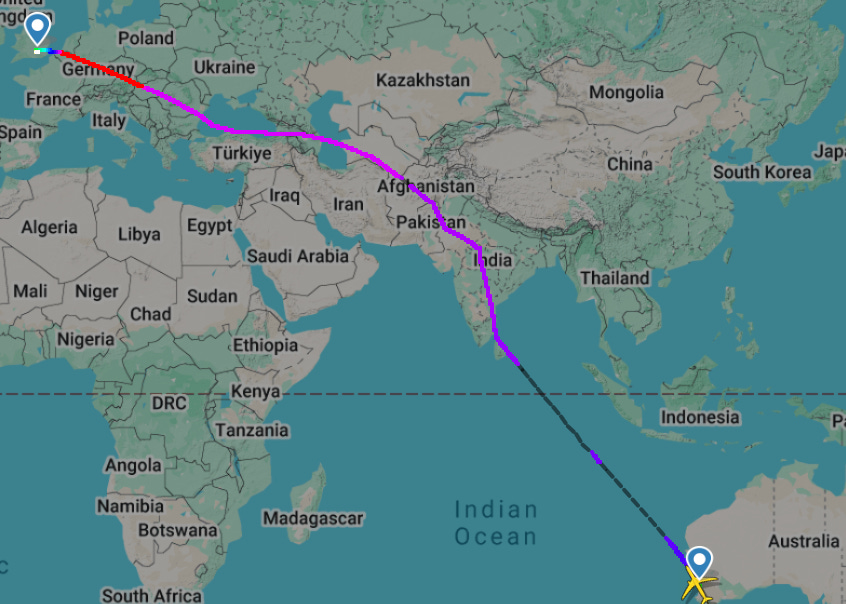
Airspace closures in the Middle East have forced Qantas to temporarily reroute its non-stop Perth-London flight (QF9) as a one-stop service via Singapore (QF209). The change is necessitated by larger payload restrictions that limit the passenger load as the flight now traverses a longer routing via Pakistan, Afghanistan and the Caucasus, instead of its more typical routing through the Middle East (either Iraq or Saudi Arabia).
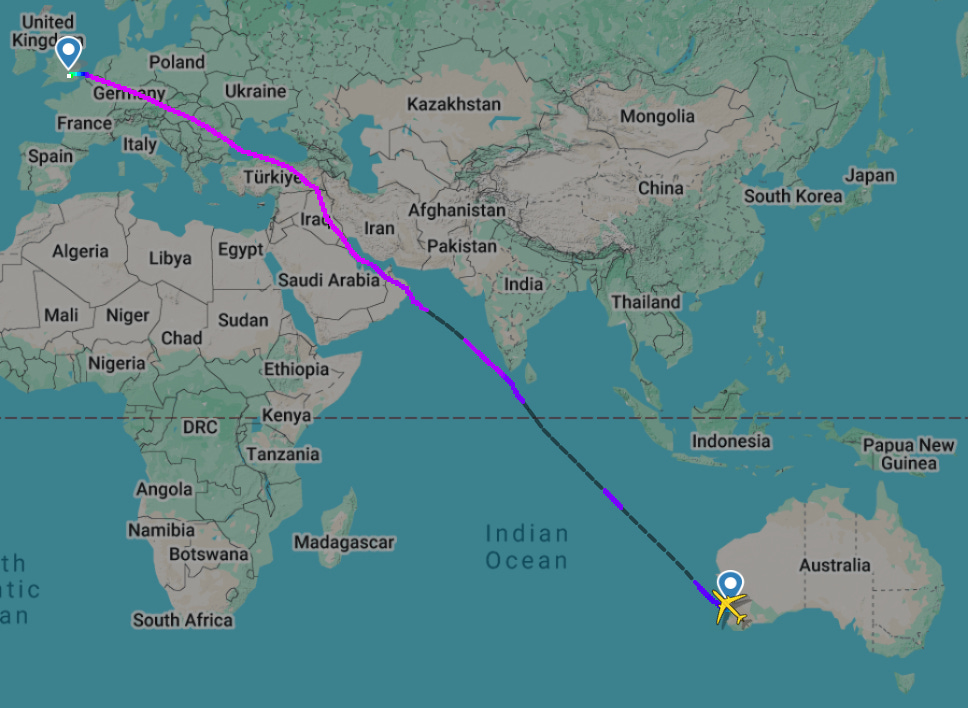
The northerly routing adds 30 to 45 minutes to the flight time. This seems like a small amount of additional time, so why such a significant payload restriction necessitating a refuelling stop? It’s easy to forget that even at the best of times, QF9 is one of the world’s longest non-stop flights, pushing the capability of the B787-9.
It’s also not the first time Qantas have rerouted QF9, having done it twice in 2024 for similar reasons (12-27 April and 8-22 August). As with the previous times, the return leg (QF10) remains non-stop.
Analytic Flying is a reader-supported publication, so please subscribe. See our ethical paywall policy to understand if you need a paid subscription (incl. industry professionals and readers using for commercial purposes).
The logistics of adding a fuel stop mean that it can’t be implemented on an ad-hoc basis or scheduled at short notice. If it were to take an unscheduled stop it would certainly lead to the crew exceeding their flight duty limits, leading to the remainder of the flight being cancelled. This would lead to greater disruption for passengers and knock-on effects to the rest of the network with an aircraft and crew being out of position for at least 24 hours.
Scheduling the fuel stop in advance takes time as a replacement crew needs to be positioned to Singapore ahead of time. Singapore isn’t a regular Qantas B787 station, limiting its ability to utilise crew that may already be in position. Thus, despite the first airspace closures occurring on Saturday 28 February, Qantas only began the rerouted QF209 on Wednesday 4 March.

In the interleading time QF9 continued to operate non-stop, utilising the longer northerly routing, taking a payload penalty to carry additional fuel and/or lighted the load to reduce fuel burn. But just how big of a penalty is it?
Qantas were on record saying that introducing the Singapore stop would enable an additional 60 passengers to be carried. That’s a surprisingly large number for an aircraft that only seats 236 passengers, right? Were they really limited to just 176 passenger?
It’s actually missing some context! Firstly, we shouldn’t assume that QF9 was able to operate with a full passenger load prior to Saturday’s disruptions. Furthermore, we also shouldn’t assume that it can do this year round.
As usual, we brought the receipts! We’re able to estimate the payload restrictions that Qantas typically face on the route by analysing the declared seat capacity on QF9 and 10 from BITRE data.
Over the last year, the outbound seat capacity on QF9 (westbound Perth to London) averaged 219 seats per flight, while the inbound seat capacity on QF10 (eastbound London to Perth) averaged 235 seats per flight. We can interpret this to mean that they had to leave 16 seats empty on the average westbound sector, but just 1 empty on the average eastbound sector.
More importantly, we see significant variation in the payload restrictions throughout the year. Seat capacity was as low as 203 in January 2025, and as high as 234 in August and September 2025. There is also a clear seasonal pattern, with payload restrictions significantly more severe through the Australian spring and summer.
Back to our analysis, capacity was limited to an average 206 and 219 seats in February and March 2025. If we were to assume that this holds for February and March 2026, this would indicate a loss of 30 and 17 seats even before the rerouting. So the question becomes, how does the rerouting lose and additional 30 to 43 seats?
Thanks ACARS!
We have a single snapshot to show this in practice using the ACARS loadsheet for QF9 on 3 March. We don’t generally see Qantas’s loadsheets on ACARS since they’re typically not transmitted to the aircraft via ACARS (at least not utilising methods that allow us to see them). However, they tend to be transmitted by ACARS when flights are departing from outstations or when there are late changes. Basically, we got lucky!
We picked it at the time and referenced to it in some exchanges on social media, but we thought that it deserved more detailed analysis. QF9 on 3 March was the last non-stop to London before the rerouting via Singapore and it shows us just how challenging things were.
The loadsheet indicated TOB of 172 meaning “total on board” of 172. As an aside, during the Bad Bunny charter shenanigans a few weeks back some people misinterpreted this number as passengers on board. This isn’t passengers on board, but total, thus including crew. The flight typically has 16 crew member including 4 flight deck and 12 cabin crew, meaning that there were 156 passengers on board. Provided this was the full load that they could’ve carried it means the rerouting could carry 80 more, not 60, but we’ll give them some latitude here.
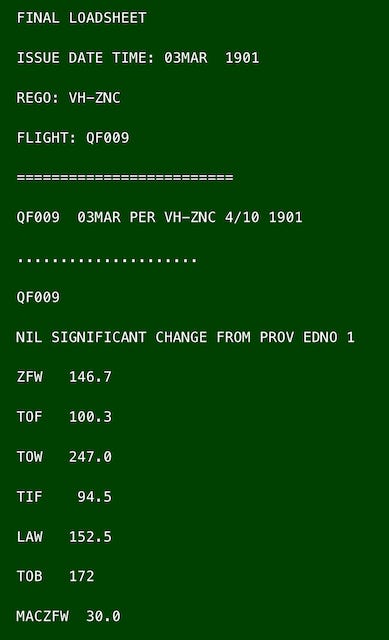
But this is where it gets really interesting! From the loadsheet we can also see that the estimated take-off weight (TOW) was 247t, well short of the aircraft’s maximum take-off weight (MTOW) of 254t. So did they leave 7t of payload behind? Well, no.
The loadsheet also tells us that take-off fuel (TOF) was 100.3t. The Boeing ACAP manual tells us that the B787-9’s physical fuel capacity is 126,429 liters or 101.5t. But does that mean they could’ve taken 1.2t more fuel? Again, no.
Fuel density varies with temperature. As temperature increases, the same weight of fuel takes up more volume. Perth is pretty hot at this time of year, and even at 7pm, temperatures are still in the low 30s (celcius). At 15C, 126,429 liters weighs 101.6t, but at 30C, the same volume weighs 100.1t.
Safe to say that the tanks were full. We’re just noting this so that people don’t critique the next part arguing that they could’ve taken more fuel. They couldn’t take more fuel, not because they were limited by weight, but because they were limited by volume!
So they were full of fuel with only 156 passengers on board and 7t short of MTOW. So why didn’t they take more passengers? Couldn’t they have increased the passenger load to increase payload by 7t and achieve MTOW?
We said Perth is hot at that time of the year, but even at 30C in still air, the B787-9 should lift nearly 250t, very close to its MTOW, and with just a small headwind it would lift MTOW. So it wasn’t take-off performance limits either.
The limits of absolute range
A few weeks back when we were analysing United’s new low density B787-9 configuration we received some criticism that our analysis didn’t take into account the impact of the B787-9’s forthcoming MTOW increase on its range.
We countered that the MTOW increase doesn’t increase absolute range because it doesn’t coincide with any increase in fuel capacity. While the MTOW increase is very useful for many missions it doesn’t change anything for missions that are already requiring the maximum fuel volume of the aircraft.
The increase in MTOW will increase the range at maximum payload, but this is already at a point where fuel has been traded for payload. The nuance here seems abstract, but its important. And this is where the rubber hits the road:
Fuel burn is a function of the weight of the aircraft. All else being held constant, a heavier B787-9 will burn more fuel than a lighter B787-9. Thus, had QF9 on 3 March carried more passengers it would’ve been heavier, burning more fuel. As we have already noted, it can’t carry more fuel, not due to weight limits, but the volumetric limit. Essentially, adding the extra flight time pushed the aircraft to its absolute range.
And that’s the real issue for QF9. It’s already at or so close to its absolute range. And further endurance needed, for example by taking a longer northerly routing can’t be made-up but trading payload to carry more fuel, rather it needs to reduce payload to reduce fuel burn. In some respects, it’s so close to the edge of its absolute range that its far more sensitive to the effect of a longer routing.
Some implications
Adding a fuel stop creates logistical challenges, but also may adds significant flight time, increasing the block time between Perth and London from from 17.5 hours to more than 20 hours. If sustained this may reduce the popularity of the flight with passengers, although it appears moot as long as significant capacity constraints exist at a market level with continued Middle East disruptions.
The positive externality is that it generates a significantly larger net gain in capacity. On the presumption that it can now carry a full passenger load it adds as much as 80 seats compared to the constrained longer non-stop routing. Comparatively, QF9 on 3 March lost between 50 and 63 seats compared to February and March averages. This is where Qantas is probably getting its 60 passenger number from, but as we can see, the number might be a little higher.
Another consideration is whether the Singapore stop would need to remain year round. As noted earlier, payload restrictions are less significant in the Australian autumn and winter. By August, near full passenger loads can even be carried on the typical non-stop routings. However, as we also noted earlier, this isn’t the first time Qantas have rerouted QF9, and one previous rerouting was implemented 8-22 August 2024, suggesting that Qantas will maintain the rerouting year round if the situation were to persist.
We hope this has been instructive, highlighting just how significant the payload restrictions become when adding an extra 30 to 45 minutes flying time to QF9, and why the Singapore stop is both necessary and useful at the current time given the significant supply constraint in the market.
Also, it goes a long way to show that the forthcoming increase in the B787-9’s MTOW just isn’t going to be much use for ULH flights since this isn’t the binding constraint on range.
What was the Underload? I couldn't see it in the ACARS data